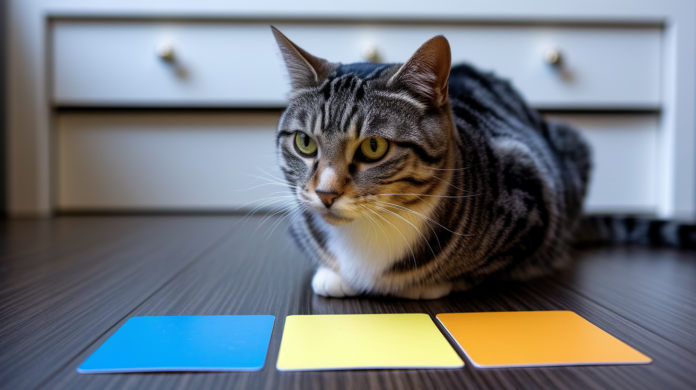

Think your cat sees the same colors you do?
Think again.
Cats are not little humans when it comes to color.
Their eyes have two cone types, so blues and yellows stand out while reds and greens wash out into browns or grays.
That matters when you pick toys, bedding, or training rewards.
If you want your cat to notice and play, choose bright blues or yellows and high-contrast patterns.
Here’s a clear, practical look at what colors cats actually see and how to use that for better play and enrichment.
Core Explanation of Cat Color Vision and What Colors Cats Can See
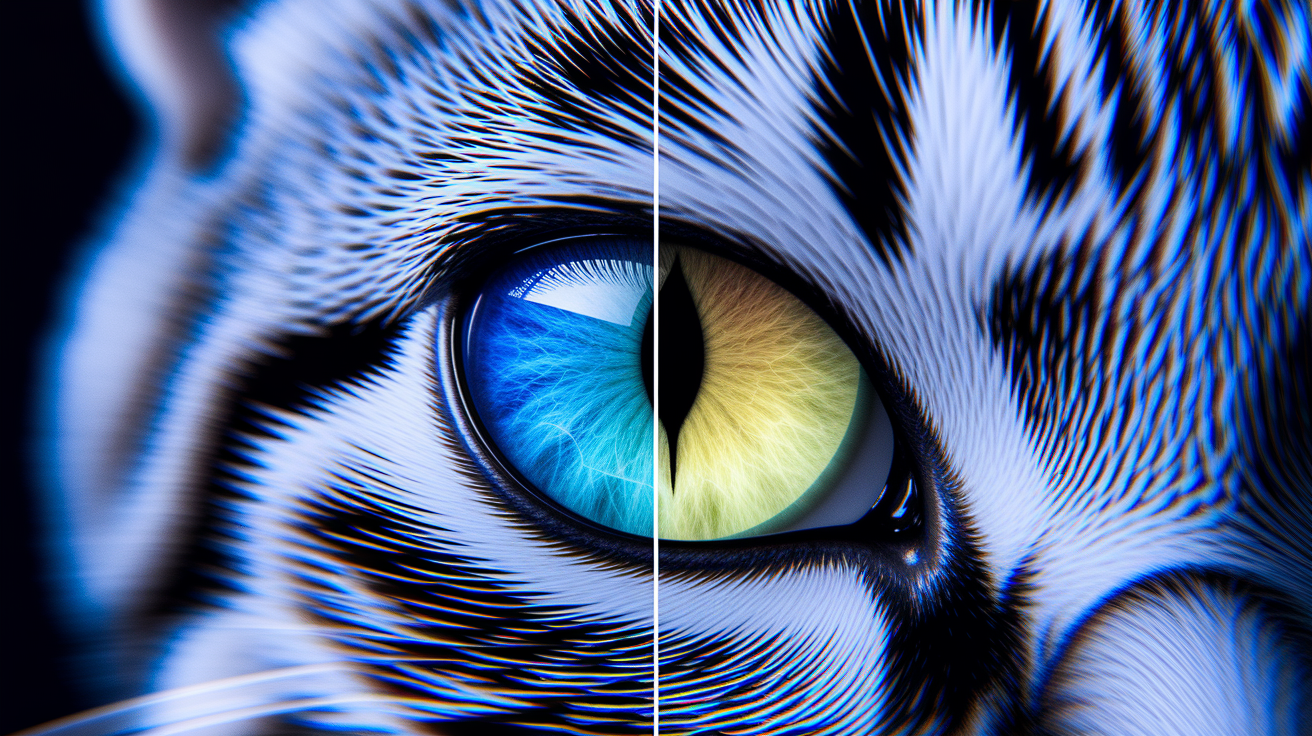
Cats are dichromats. Their retinas have two types of cone photoreceptors instead of the three you’ve got. One cone picks up short wavelengths around 400–460 nanometers (blues and violets), and the other responds to medium-to-long wavelengths, roughly 500–560 nanometers (yellows and greenish tones). This two-cone setup means cats reliably see blues and yellows but struggle with reds and greens. Think of it like this: cats see the world a bit like someone with red-green color blindness. Blues pop, yellows are clear, and reds blur into something much duller.
Red, orange, pink, and many greens don’t register the way they do for you. That bright red toy or blanket? Probably looks like a dark brown, gray, or black object to your cat. Orange shifts toward muted brown or tan. Pink, which is just a lighter red, also looks grayish or washed out. Green objects often appear yellowish or brownish, depending on brightness and the wavelengths they reflect. Your cat isn’t ignoring the red ball because she’s bored. She may simply see it as a dim, low-contrast shape against the carpet.
This color-vision difference exists because cats evolved as crepuscular hunters, active at dawn and dusk when color cues matter less than motion, contrast, and low-light sensitivity. Their retinas are packed with rod photoreceptors for detecting movement and navigating dim environments. Less room for the cone diversity needed to see a full spectrum. The result is a visual system built for survival in twilight, not for appreciating the vibrant reds and greens that matter to diurnal primates like us.
Cat Eye Anatomy and How It Shapes Color Perception
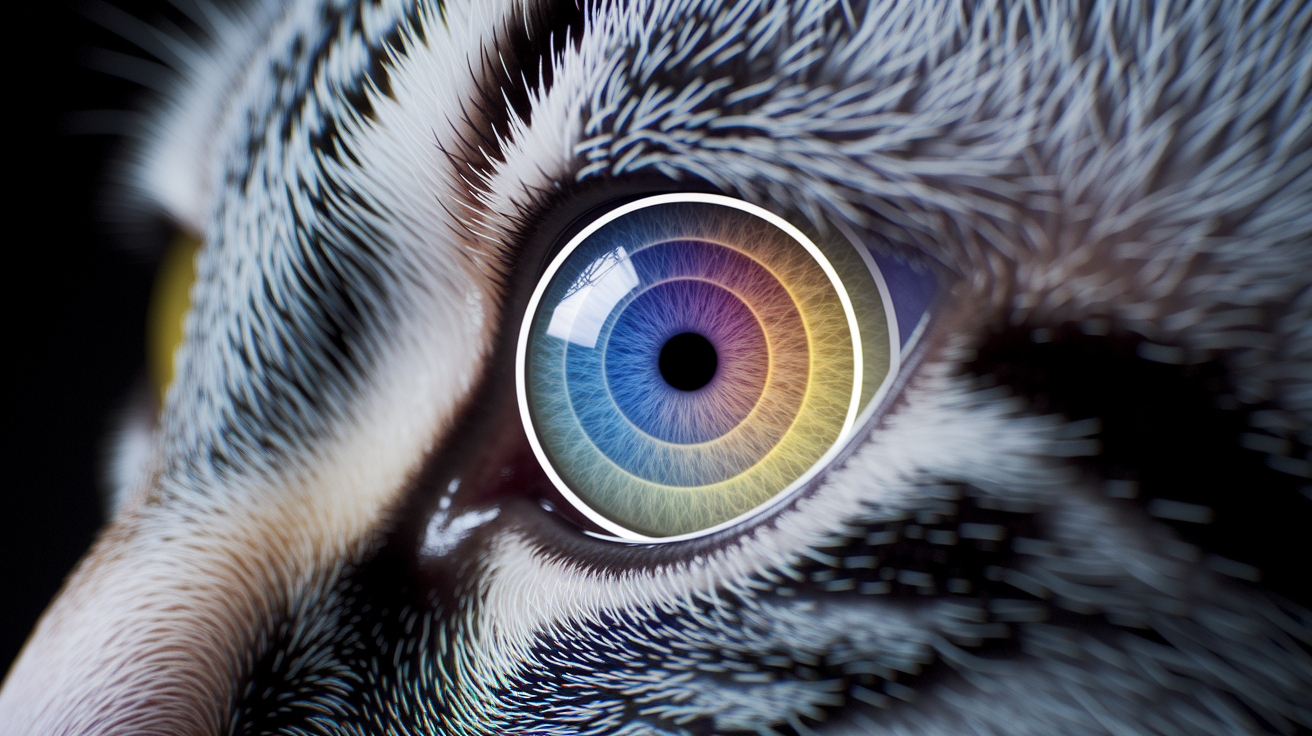
The feline retina is dominated by rod photoreceptors, which detect light intensity and motion but contribute nothing to color vision. Cats have roughly six to eight times more rods than humans, giving them exceptional sensitivity in low light and a remarkable ability to track fast-moving objects. Color perception falls to the cone cells, and cats possess only two cone types compared to your three. These two cone classes respond to different wavelength ranges (short for blue/violet and medium-to-long for yellow/greenish), but the sparse distribution of cones across the retina limits color resolution even in bright conditions.
Unlike you, cats lack a true fovea. Humans have a dense central patch of cones called the fovea for sharp, color-rich central vision. Cat cones are scattered more evenly across the retina, which means there’s no specialized zone for fine color detail. Visual acuity in cats is commonly estimated at around 20/100 to 20/200. A cat sees at twenty feet what you see clearly at one hundred to two hundred feet. This lower acuity applies to both shape detail and color discrimination, so even colors within their range appear less vivid and distinct than they do to you.
The tapetum lucidum (a reflective layer behind the retina) amplifies incoming light by bouncing photons back through the photoreceptors a second time. This structure is why cat eyes glow in the dark and why cats excel in dim environments. But the scattered light also reduces sharpness and fine color discrimination, reinforcing the trade-off between low-light performance and color clarity.
- Two cone types sensitive to blue/violet (≈400–460 nm) and yellow/green (≈500–560 nm) wavelengths
- Rod-to-cone ratio heavily favors rods, boosting motion and low-light detection at the expense of color richness
- No central fovea for concentrated color vision, resulting in lower overall color resolution
- Tapetum lucidum increases usable light but scatters it, reducing sharp chromatic detail
- Visual acuity of roughly 20/100–20/200 limits fine discrimination of both shape and hue
Human vs Cat Color Vision Differences
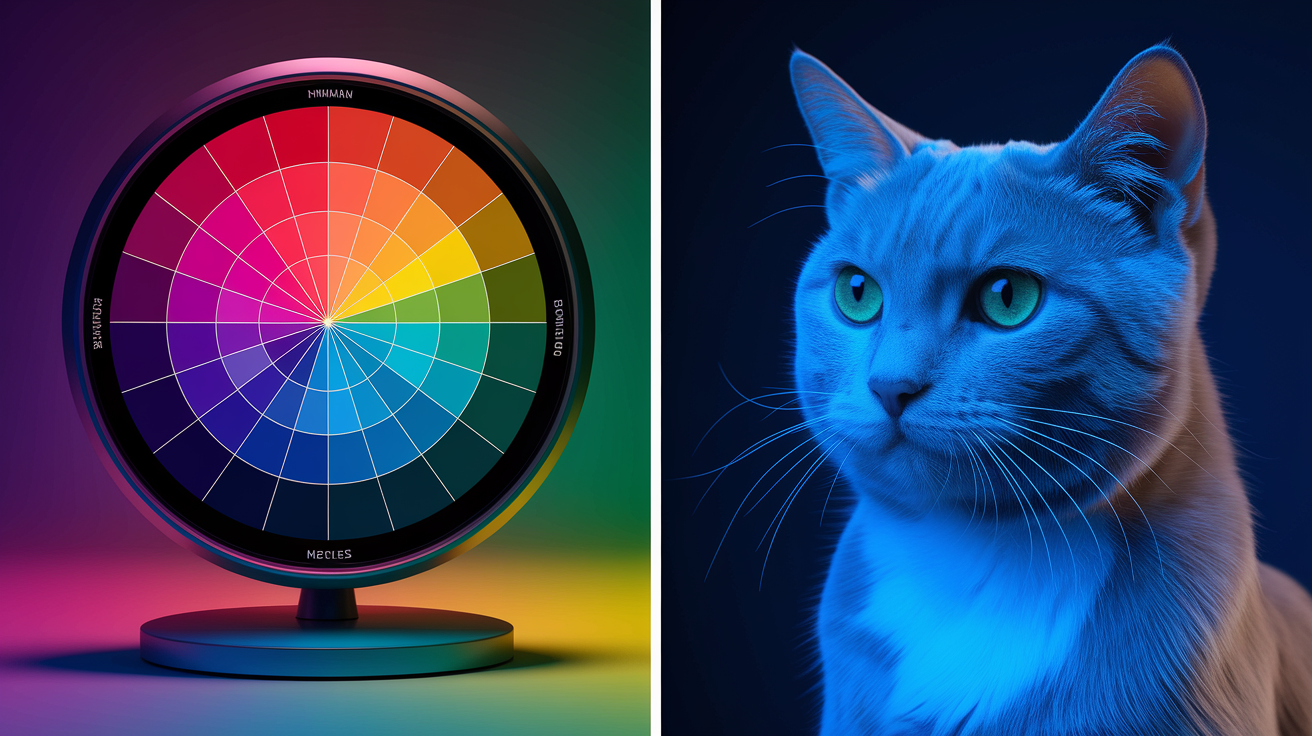
Humans are trichromats, equipped with three cone types that respond to short (blue), medium (green), and long (red) wavelengths. This three-cone system lets you distinguish a wide spectrum of hues, from deep reds through oranges, greens, blues, and violets. Cats, with only two cone types, lack the middle cone class responsible for separating red from green. Their color palette is closer to what a human with red-green color blindness experiences. Where you see a rainbow of distinct bands, a cat sees blues, yellows, and a lot of ambiguous browns and grays.
Beyond cone count, the two species differ in field of view and performance across lighting conditions. Cats enjoy a total visual field of roughly 200 degrees compared to your range of about 180 degrees, giving them superior peripheral awareness for spotting movement. You have sharper central detail and better color discrimination in daylight. Cats excel when light is scarce, thanks to their rod-heavy retinas and reflective tapetum lucidum, but that low-light advantage comes with reduced ability to resolve fine color differences even when the sun is up.
| Species | Cone Types | Distinguishable Colors | Visual Acuity | Low-Light Advantage |
|---|---|---|---|---|
| Human | 3 (short, medium, long) | Full red–green–blue spectrum | ~20/20 (normal) | Moderate |
| Cat | 2 (short, medium-to-long) | Blues, yellows; limited red–green | ~20/100–20/200 | High (6–8× more rods, tapetum lucidum) |
What Individual Colors Likely Look Like to Cats
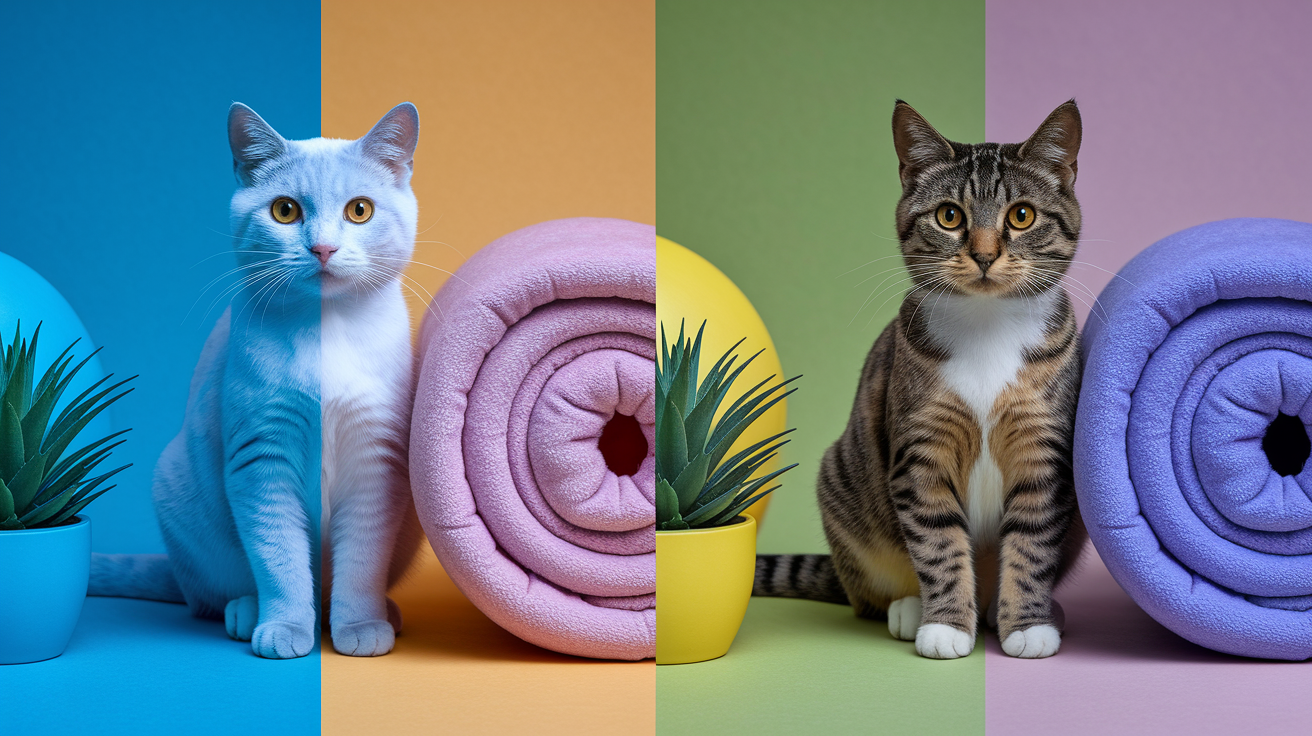
Blue and yellow remain the clearest, most vivid colors in a cat’s world. A bright blue toy or a yellow ball will stand out against most backgrounds because those wavelengths match the peak sensitivities of feline cone cells. Violet also registers well, appearing as a strong blue tone. If you’ve noticed your cat repeatedly choosing the blue feather wand over the red one, it’s not a quirk. It’s physiology. Blue and yellow simply look more distinct and interesting.
Green occupies a middle zone where perception shifts depending on the shade and brightness. Many greens contain wavelengths that overlap with the yellow-sensitive cone range, so a medium green object may appear yellowish or brownish to your cat. Darker greens can look like muddy browns. Bright lime greens may seem more yellow than green. There’s no sharp “green” experience for cats the way there is for you. Instead, green blends into the yellow-brown continuum.
Red, orange, pink, and purple hues present the biggest challenge. Red falls outside the reliable sensitivity range of both feline cone types, so it often appears as a very dark brown, gray, or nearly black. Orange shifts toward brown or tan. Pink, being a light red, looks like a pale gray or washed-out beige. Purple, which contains blue wavelengths, may appear as a muted blue rather than the rich violet-red blend you perceive. Brightness and contrast matter far more than hue in these cases. Your cat can see that the object is there and whether it’s light or dark, but the “redness” you associate with a cardinal or a rose is simply absent.
- A bright red ball that you see vividly likely appears as a dark brown or gray sphere to your cat.
- An orange toy mouse shifts to a brownish or tan object in feline vision.
- A pink blanket looks more like a pale gray or beige surface.
- A purple pillow registers primarily as blue, losing the red component entirely.
- A green plant may seem yellowish or muddy brown, depending on its exact shade and lighting.
Practical Applications: Choosing Toys, Enrichment, and Home Items Cats Can See Well
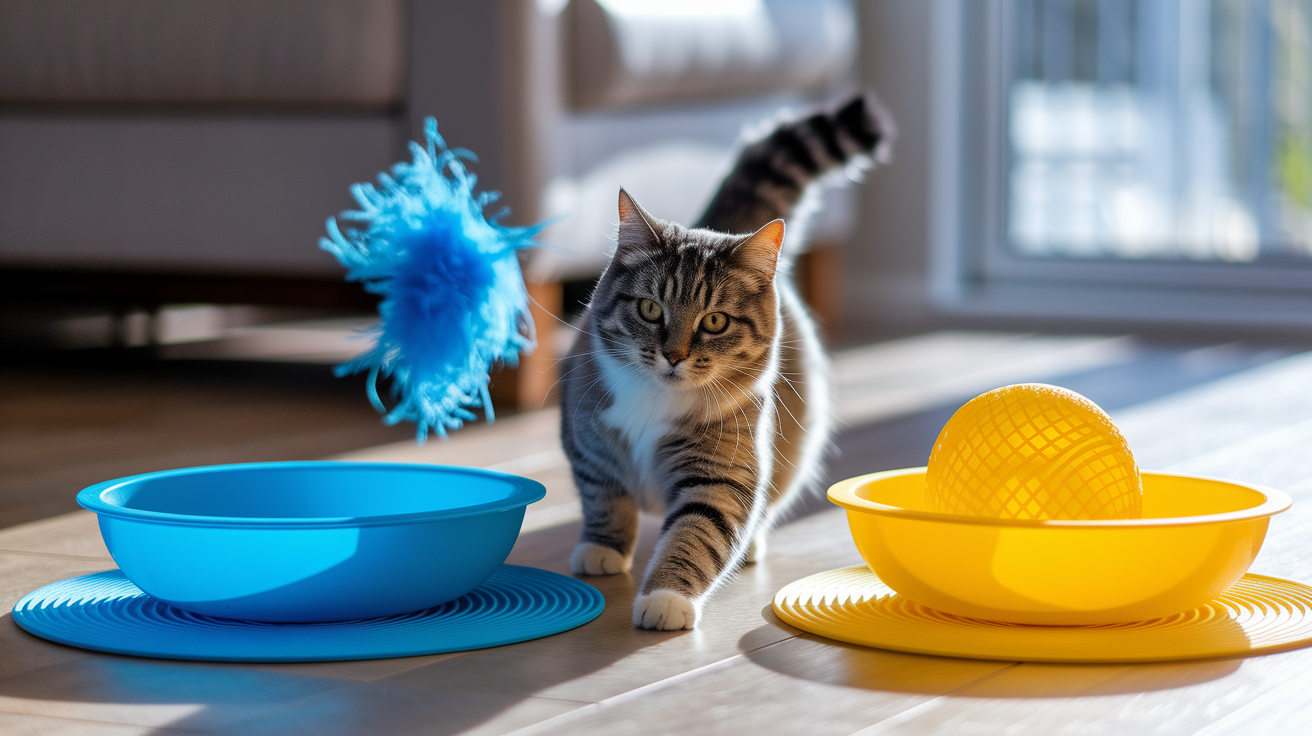
When shopping for toys or setting up enrichment activities, prioritize blue, violet, and bright yellow items. These colors fall squarely within your cat’s dichromatic range and will appear more distinct against typical household backgrounds like beige carpet, gray tile, or wood floors. A blue feather toy or a yellow crinkle ball will catch your cat’s eye far better than a red or pink equivalent, which may blend into a dull, low-contrast blur. If the toy also moves unpredictably or makes noise, you’ve combined color visibility with the motion and sound cues cats instinctively track.
Red toys aren’t useless, but don’t rely on their color alone to grab attention. A bright red mouse may look like a dark brown lump to your cat, so pair it with texture, scent, or a rattle inside. High-contrast patterns work better than subtle color gradients. Dark stripes on a light background, or light polka dots on a dark fabric. Cats notice edges, shadows, and movement more readily than they notice whether something is cherry red or crimson. Think less about matching your decor and more about creating visual pop through lightness and darkness.
Lighting plays a bigger role than many owners realize. Under bright indoor or natural light, your cat’s limited cone function can still discriminate blue from yellow, though not as sharply as you do. In dim conditions, color cues fade almost entirely, and your cat switches to relying on rods for motion, contrast, and general brightness. A yellow ball that’s easy to spot in afternoon sun may become nearly invisible on a beige rug at dusk, not because the color disappeared but because low light reduces all chromatic signals. If you’re doing evening play sessions, use toys with reflective or glow-in-the-dark elements, or simply turn on more lights.
- Choose blue, violet, or bright yellow toys for the strongest color contrast your cat can perceive.
- Avoid relying on red or pink items as primary visual cues. Pair them with texture, sound, or scent.
- Use high-contrast patterns (light on dark or dark on light) rather than subtle color blends.
- Add reflective or glow elements to toys used in low-light play sessions, since color discrimination drops in dim conditions.
- Consider feeding-station color coding. Place blue or yellow mats under bowls to help cats with vision changes locate food more easily.
- Check toy visibility on your floors. A blue toy on dark tile stands out. A red toy on brown carpet may vanish from your cat’s perspective.
Behavioral Experiments and How Researchers Test Cat Color Vision
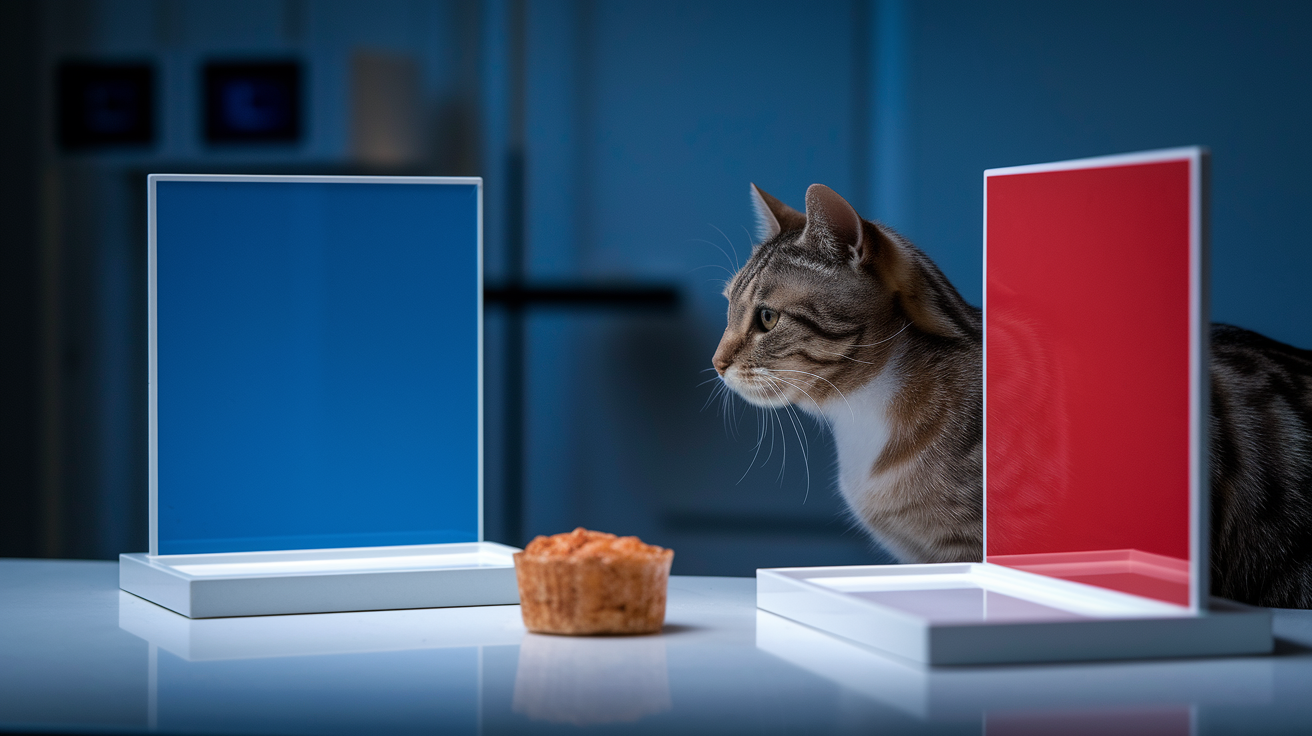
Scientists have studied feline color vision for decades using reward-based discrimination tasks, in which cats learn to associate specific colors or wavelengths with food or other rewards. In a typical setup, a cat is presented with two illuminated panels or cards of different colors and trained to touch or approach one to receive a treat. By systematically varying the wavelengths and brightness of the stimuli, researchers can determine which color pairs a cat can reliably tell apart and which ones look identical. These experiments confirm that cats distinguish blue from yellow with high accuracy but struggle or fail entirely when asked to separate red from green.
More controlled studies use monochromatic lights (single-wavelength sources) to map the spectral sensitivity of feline photoreceptors. By recording which wavelengths elicit a behavioral response and which don’t, scientists have pinpointed the approximate peak sensitivities of the two feline cone types. Additional tests measure contrast-detection thresholds, revealing that cats rely heavily on brightness differences when hue alone is ambiguous. Together, these methods paint a consistent picture. Cats have genuine color vision, but it’s limited to a blue-yellow axis.
Early research into feline vision dates back several decades, with foundational work in the mid-twentieth century establishing that cats are not fully colorblind. Those initial studies laid the groundwork for more precise wavelength mapping and comparative anatomy, which later confirmed the two-cone structure and explained why cats’ color world resembles that of humans with red-green color deficiency.
How Card-Choice Experiments Work
In a card-choice trial, a cat sits in front of two cards or panels (one colored blue and one colored red, for example) mounted at the same height and distance. A small food reward is hidden behind one card, always the blue one. Over many trials, the cat learns that choosing blue leads to food. Once the association is solid, researchers test whether the cat still picks blue when brightness is adjusted or when a new color pair is introduced. If the cat continues to select blue over red but fails to distinguish red from green, the data confirm blue-yellow discrimination and red-green confusion. This simple, repeatable method has been adapted across labs and species, providing robust evidence of dichromatic vision in domestic cats.
Age, Health, and Vision Problems Affecting Color Perception in Cats
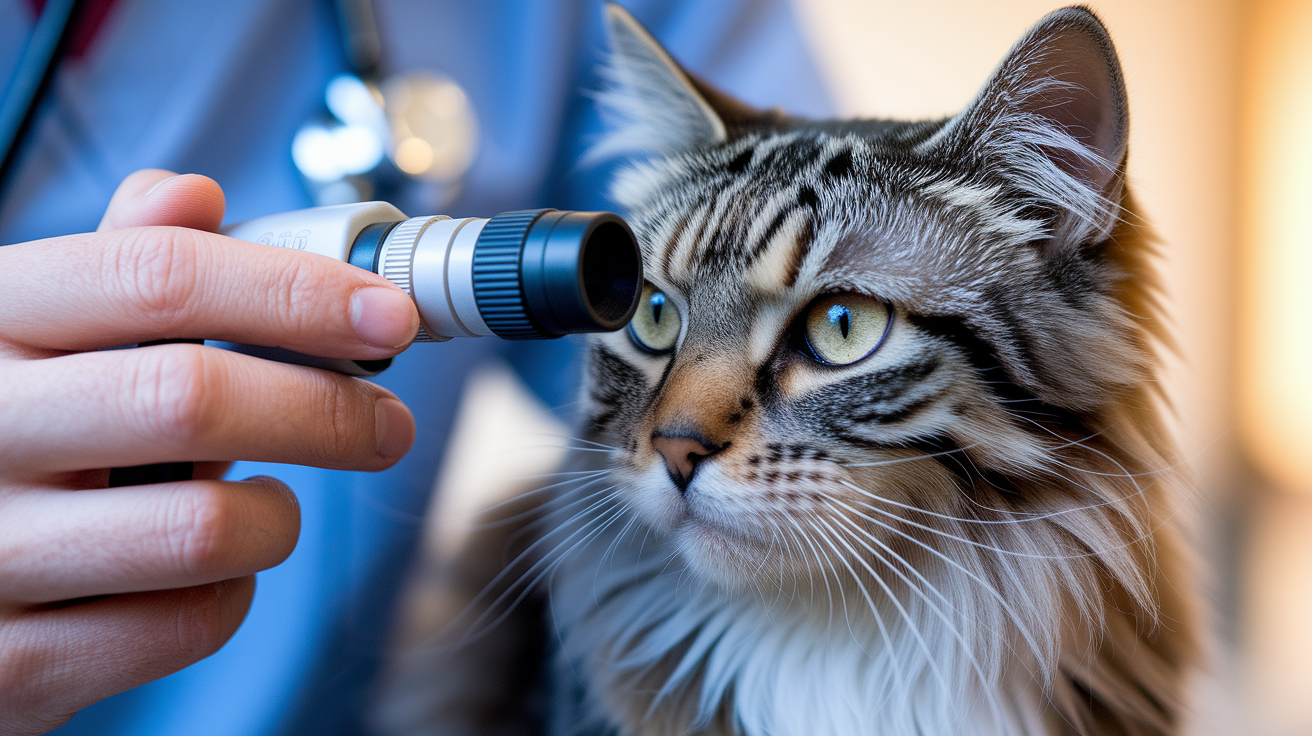
Kittens are born with closed eyelids and rudimentary vision. Their eyes open around seven to ten days of age, but functional color vision doesn’t fully develop until several weeks later as cone photoreceptors mature and neural pathways in the brain refine. During the first few weeks of life, a kitten’s world is mostly blurry shapes, brightness differences, and motion cues. By the time a kitten is weaning and beginning to play, the two-cone color system is generally operational, though overall visual acuity continues to improve through early kittenhood.
Adult cats can lose or degrade color perception due to eye diseases, systemic illness, or injury. Cataracts (clouding of the lens) reduce the amount and quality of light reaching the retina, which dims color signals along with overall brightness. Retinal diseases such as progressive retinal atrophy or detachment directly damage photoreceptors, sometimes destroying cones before rods and leaving a cat with even less color discrimination than normal. Glaucoma and uveitis can also impair vision, though these conditions often affect motion and brightness perception more noticeably than color. Inherited disorders are less common but do exist in certain breeds, occasionally leading to early-onset vision loss.
Senior cats often experience a gradual decline in contrast sensitivity and visual sharpness, similar to aging humans. Cone function may weaken, making it harder to distinguish even the blue-yellow colors that were once clear. But because cats rely so heavily on rods, motion detection, and brightness cues, the loss of subtle color discrimination usually goes unnoticed by owners. A twelve-year-old cat may see less vivid blues and yellows but will still navigate the house, hunt toys, and respond to movement without obvious difficulty.
- Dilated pupils that don’t respond to light changes can signal retinal or neurological problems affecting photoreceptors.
- Bumping into furniture or hesitating at stairs, especially in dim light, may indicate declining rod function or overall acuity loss.
- Reluctance to jump or misjudging distances suggests reduced depth perception, often linked to binocular-vision decline rather than color loss alone.
- Cloudiness or discoloration in the eye (visible cataracts or lens changes) reduces light transmission and can dull both color and brightness perception.
Simple At-Home Activities to Observe Your Cat’s Color Recognition
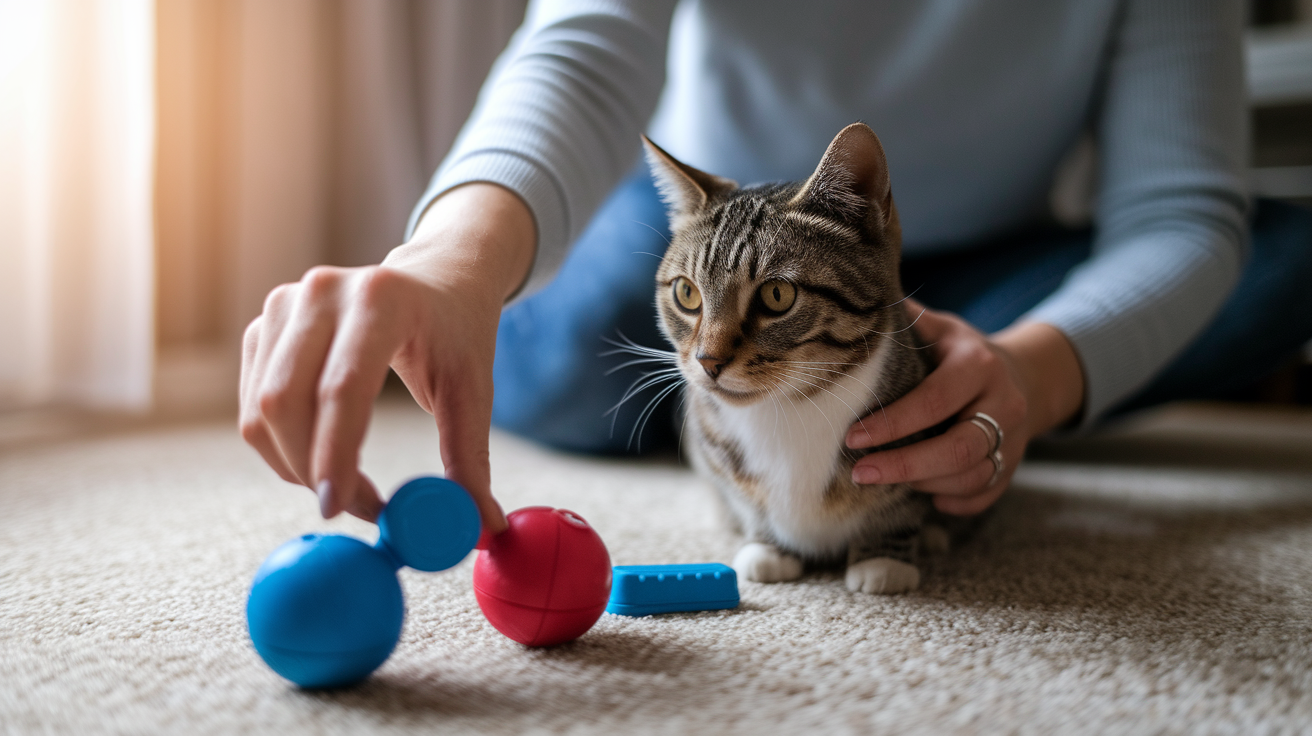
You can run informal tests at home to see how your cat responds to different colors, but keep expectations realistic. Cats use motion, scent, texture, and brightness alongside color, so a “preference” for one object over another may reflect multiple cues, not color alone. Dim lighting will wash out chromatic signals entirely, and individual cats vary in motivation and focus. These activities are more about observing behavior than proving scientific facts, and they work best when your cat is alert, playful, and not distracted by hunger or stress.
- Gather two identical toys in different colors (one blue and one red) and place them side by side on a neutral surface. Light gray or beige works well. Toss each gently or wiggle them to add motion, then step back and see which one your cat approaches first. Repeat the test several times, swapping positions to rule out location bias.
- Use colored paper cards (blue, yellow, red, green) taped to the floor in a row. Drop a treat behind one color consistently (always behind blue, for example) and see if your cat learns to check that color first. This mimics the reward-based discrimination tasks researchers use.
- Test contrast over color by offering two toys of similar hue but different brightness. A dark blue ball and a light blue ball, say. If your cat shows no preference, brightness may matter more than the specific shade.
- Try a puzzle feeder with color-coded compartments. Place treats under blue and yellow lids but leave red and green lids empty. Track whether your cat learns to skip the red/green options faster or shows any pattern in her choices.
- Observe outdoor or window behavior. Note whether your cat tracks blue jays or yellow butterflies more readily than red cardinals or brown sparrows. This won’t isolate color from motion or size, but it can hint at which visual cues grab attention.
If your cat consistently gravitates toward blue or yellow items and ignores or shows less interest in red or green ones, you’re likely seeing her dichromatic vision in action. If she picks randomly or always goes for the object that moves most, that’s normal too. Motion and novelty often trump color. Either way, you’re learning what your individual cat notices and enjoys, which is more useful than any generalized color chart.
Final Words
You now know cats are dichromats with two cone types that pick up roughly 400–460 nm (blue/violet) and 500–560 nm (yellow/greenish). Blues and yellows stand out; reds and greens look muted or gray.
We also covered eye anatomy, simple behavior tests, and practical tips for toys and home items. Watch for age or eye issues that change how your cat sees.
If you still wonder what colors can cats see, try a few safe items, note your cat’s choices, and enjoy clearer, more fun playtimes together.
FAQ
Q: What colors do cats see the best?
A: Cats see blues and yellows best because they have two cone types tuned near 400–460 nm (blue) and 500–560 nm (yellow/green). Reds and greens usually look muted, brownish, or gray to cats.
Q: Is there a 3-3-3 rule for cats?
A: The 3-3-3 rule for cats is a rough settling timeline: 3 days to feel safer, 3 weeks to build routines, and 3 months to feel at home. Some cats need more or less time.
Q: How do cats say “I’m sorry” and how do I say “I love you” in cat?
A: Cats show “I’m sorry” with slow blinks, head-butts, nudges, or calm closeness. To tell a cat “I love you,” return slow blinks, offer gentle petting, consistent care, and give them respectful space.